
Table of Contents
I didn't exactly win the genetic lottery when it comes to vision. Both my parents wear thick glasses, my late grandparents were short-sighted too, and a lot of my relatives don't see super well either.
So it wasn't too much of a surprise to anyone, when I started watching TV from maybe a meter from the screen, that I most likely will need glasses too. I don't exactly remember my original prescription, but based the fact that I had to sit this close to see clearly means it probably was several dioptres from the get go.
Over the years my issues compounded. My myopia got worse, I was also diagnosed with astigmatism, and eventually also with strabismus divergens.1 All of these were things glasses could mitigate and, for around 18 years of my life, that was fine by me.
However, by the time I was in my mid-twenties my eyesight worsened to -7.5 / -6.75 dioptres, with -0.75 cylinders on each eye. In practical terms, this meant that I was able to see clearly about 20 centimetres in front of me, after which the world quickly blurred into vague shapes and difficult to discern blobs. My glasses too grew thicker and thicker, my last pair having lenses that were easily almost a centimetre thick.2
Even this would've been fine, if not for…
1. The issue that broke the camel's back

Figure 1: Simulation of what I've seen. This effect is a type of Chromatic aberration.
I'm a frontend developer by trade. Not exactly a graphics designer, mind you, I still pretty much just bash rocks together until they look nice enough, but visuals are still part of my job.
Well imagine my shock when, during some project I'm not even wholly remembering anymore, I noticed that all the red and blue text on my site were a tiny bit misaligned. Not horribly so, a millimetre or two at most, but enough to bother me. What's worse, no matter how much I scoured my code, I couldn't find a reason for this discrepancy.
While different fonts can wildly differ with the same settings due to their inherent line-heights and such, the same font randomly floating higher or lower due to a colour difference sounded plain silly.
So silly in fact, that I started to see if I could find any other places where this happened. It happened on every other site I checked.
And, what's worse, nobody else I asked could see it!
I realized with some horror, that this was not an issue with CSS, nor even with my PC. The problem was with my vision.
I was a little devastated and a bit scared too. Bad eyesight is one thing. Sure, stuff is blurry and hard to make out, but reality is still reality. But having things move in impossible ways? That's a whole another ballpark and one I was not happy to be a member of.
And sure, we're talking about millimetres, but that's millimetres too much. I mentioned this to my local optometrist, but they couldn't really figure out anything, largely due to their lack of tools. I was running out of ideas when I noticed that if I take my glasses off, I could no longer see this issue.3
My feelings were twofold: On one hand, massive relief. "Thank goodness, it's not my eyes." On the other hand, I also felt a sense of disappointment and worry. Glasses were no longer wholly-reliable tools. From now on, they'd be their own potential cause of issues.
There were, of course, a couple of options to resolve this problem, such as:
Get glasses with thinner lenses: Prohibitively expensive. A set of good, mid-range glasses cost about 400€ where I live. This means a decent frame, moderately thinned lenses, maybe even a protective coating. Nothing fancy, but it also won't snap off your face at the worst moment.
"Good" glasses in comparison can easily cost 600 to 800€. Technically, I could afford this, having a programmer's salary helps a lot, but it just feels a bit too much for a device you most likely need to replace in 1-2 years anyway.4
Contact lenses: I'll be honest, I was never too good with touching my eyes. I hate eye-drops and I instinctively shut my eyes real tight whenever anything gets close to them. This, along with the fact that contacts aren't exactly the safest option long-term and the recurring cost kept me away.
I know normal contact lenses aren't that expensive, but because of how, erm, 'special' my eyes were, I couldn't just get off the shelf ones. They gave me a quote when I asked and said it'd be about 100€ / month for my supply, with no real option to involve social insurance.
Considering it would've cost me nearly 1200€ a year to get a pack of tiny disks to splat on my eyes, I was not rushing to get them.
Laser eye surgery: If you've read the title and description of this post, you already know this was my ultimate choice, but it wasn't one I've made easily.
This is partly my fault for not informing myself better earlier, partly my environment's, but I used to believe LASIK was still a much more primitive procedure than what they actually do today. My only second-hand experience was my grandfather, who underwent cataract surgery (which isn't even the same thing!), so I thought LASIK was all about doctors hacking and slashing your eyes until they can correct your vision.
Also, as is the common thing with all of these options, splurging around 2000€ isn't exactly something one does willy-nilly. Especially when the average person here makes about 1300€ post-taxes.
2. The breakthrough
For a while, I learned to live with this issue, always being slightly bothered by it, but never to the amount that I wanted a solution now.
That is, until I was doomscrolling on YouTube one night and I saw a video about LASIK. I'm not even sure why I got a recommendation like that. I don't tend to watch medical videos much (well, except for good old Dr. Bernard at ChubbyEmu) and especially not eyesight related stuff, but one way or another the algorithm figured it might be something I'd be interested in and morbid curiosity got the better of me.
The realisation was a little shocking, but I found out that not only is the operation a lot less gruesome than I thought, I was also not nearly as grossed out as I thought I'd be.
This sent me down a path of research:
I read a ton of posts on /r/lasik and (beyond a couple of bad cases) people were raving about the life-changing effect this operation had on them. I read a couple of medical journal summaries,5 watched videos of doctors talking about the procedure and read their comment sections. I also talked with some friends and colleagues who opted to do LASIK and they all sounded very enthused.
I also visited the "other side" to get a better picture, so I went to /r/lasiksupport, which is a subreddit dedicated to people who had problems with their eyes after undergoing the procedure. I admit, much of what I read there was daunting, but the sub also had an air of fanaticism around it, with people calling the surgery "mutilating your most delicate organ" and the doctors who do such procedures "butchers".
It's not that I want to dismiss anyone who had bad experiences. I'm sure many of the people writing there are genuinely distraught. My heart goes out to them and I hope their problems can eventually be fixed. I also don't believe LASIK is 100% safe, there is no such thing as surgery without possible complications.
However, what I read everywhere else simply did not add up with what I read on the sub. If LASIK truly was this horrifically dangerous and unpredictable thing, then surely it wouldn't have FDA or EU approval. I also read that there are a lot of lawyers and grifters that blew the rare unfortunate cases out of proportion and turned what started as healthy scepticism into straight up FUD for profits' sake, so I figured I can't really get an unbiased view of the potential dangers from non-professionals.
After a week or so of reading/watching/discussing the topic, I felt convinced enough to want to give this whole thing a shot. I started looking up prices and ultimately settled on a local clinic that seemed both "affordable"6 and quite reputable, as they claim to have completed 150 thousand successful operations and whom had a lot of positive reviews on Google Maps.
They also had a promotion that promised to forego the price of post-op consultation and even provide you with a reasonably priced set of sunglasses (a must, as UV rays can revert the improvement for the first three-six months), so I felt like it's now or never.7
3. Pre-op tests
I registered on the clinic's site and the next day I got a call back from them. I dictated in my dioptres and cylinder values, that I don't suffer from high blood pressure or diabetes, and that I'd like an appointment as soon as possible. They offered one two weeks from the time of the call. This matched what their website claimed (they explain due to the popularity of the clinic, it's unlikely that you can get an appointment with less than two weeks wait time), so I happily accepted.
As the nurses and the doctor explained, due to my severely bad eyesight, I had to undergo a "pre-candidacy" test. Meaning they needed to see whether it's even theoretically possible for me to undergo this surgery, so that nobody's time is wasted with the more involved tests in case it turns out my eyes aren't compatible.
Thankfully I passed this with flying colours. Hell, the doctor even remarked that my eyes are unusually thick. This is not really relevant in most areas of life, but for LASIK it's a huge benefit, because people with too thin corneas can only do a subset (or even none) of the surgeries.
There was, however, one issue and a big one at that. The doctor said that while LASIK can treat myopia and astigmatism quite well, it is completely ineffective when it comes to strabismus. She explained that while my glasses seemingly "fix" the condition, I still have what's called "hidden strabismus".
What this means is that even if it's not visible to the untrained eye, my eyes still slightly point in different directions and that, even if they make my other problems go away, it's simply caused by a different issue (a weakness of the eye muscles). She also said, because I wasn't treated for it when I was little,8 she cannot guarantee that I won't start seeing double once my glasses are off. Which is not only annoying, but also a source of migraine-like headaches as the brain is unable to properly comprehend the signals the eyes are sending to it.
Before I could go on to the actual in-depth eligibility test, I was asked to seek out a specialist that could inform me better about my chances and what to do in case my strabismus becomes permanent. I was lucky to be able to book an appointment for the very same day through my company's health insurance provider, so I didn't even have to pay for the examination.
The optometrist informed me that it is her belief, that since I can see fine with glasses, my strabismus issues should also be minimized if I undergo LASIK.
She also told me I'm lacking depth perception. This took me by some surprise, because it never really caused any issues and I always just assumed I had it, but apparently I don't. I asked whether this would affect me in any shape or form, she said if it didn't bother me so far, the LASIK won't affect it one way or another.
Having my worries assuaged, I applied to the second set of tests and got another appointment for next week.
The days ticked by in anticipation. While my initial results were promising, they were not enough to decisively say if I'm eligible or not. I had neither the resigned relief of knowing I stand no chance, nor the joy of knowing for sure that I am in fact able to partake.
Finally the day came and I went to the clinic to be subjected to a regimen of tests, some familiar, some completely new. They measured my glasses, my eyesight, the pressure in my eyes,9 and did some fancy 3D scans using machines that looked straight out of some tacky sci-fi show.
After all this was done, they applied pupil-dilating eye drops and re-did all of the tests as before. I must say, I never expected these drops to be this bad. I quite literally felt like the doctor splashed acid in my eyes. It stung and burned and I had to clutch the hem of my shirt to maintain my composure.
But at least it was done fast. And the result? Based on my measurements alone, I was in fact eligible to all potential eye surgeries: PRK, FEMTO-LASIK, and SMILE!
However, before I could get any choice paralysis, the doctor quickly ruled out PRK, saying with dioptres this high, it is unlikely that PRK could give me 100% eyesight.
We then also ruled out SMILE. Though it is technically more modern than FEMTO-LASIK, I was told that those who undergo SMILE treatment can no longer have corrective surgery in the future if their eyesight regresses and the procedure doesn't really provide anything over normal LASIK in my case.
While I do hope I won't need to ever get my eyes operated again, I don't want to risk going back to glasses in case the worst comes to pass, so I chose FEMTO-LASIK.
The doctor suggested clinic's robot-assisted version, which works by pretty much "sliding onto your eyes", compared to the traditional version, where a vacuum-ring is used to keep the eye taut. This variant is slightly more expensive, but comes with two great benefits:
- One, your eyes won't get bruised, which is a common side-effect of the vacuum-rings. This is both quite ugly and I've read some previous reports where people claimed it caused them discomfort both during and after the surgery.
- Two, as I mentioned earlier, my eyes instinctively shut really hard when I feel something approaching them. This can potentially dislodge the vacuum-ring, which can cause side-effects or the failure of the surgery.
With the plan worked out, I got my final appointment for the surgery set to a week from my visit. I was ordered to get a special kind of eye drops that promote tear generation and start using it three times a day for three days before the operation to make sure my eyes are lubricated enough to work on safely.
4. The day of the operation
I arrived early in the morning a bit nervous, but just as excited. My paperwork was taken, I had to read a legal disclaimer, where the clinic informed me of all the wonderful ways things could go wrong. It wasn't exactly a pleasant list and I do find it a bit grim, that you only get this paper when you're 95% of the way there already.
Obviously, it's done so that most people will say "screw it" and proceed, but if I were making the rules, I'd force companies to put this disclaimer front and centre. Informed consent should involve enough time and a neutral environment to make your choice.
Four signatures later, I was taken for another set of tests. The nurse explained that they work only with fresh measurements in case something happened between my last visit and now.
As iffy as I found the waiver above, in this aspect I'm very glad things work this way. While it might seem a bit tedious to have your tests taken three times, in my opinion it's better to do it more times and end up not using some of the measurements, than doing it less and ending up relying on out of date stuff.
This surgery is meant to last a lifetime (or at the very least quite a few years), so that half hour spent to make sure things are still valid and correct is well-worth it.
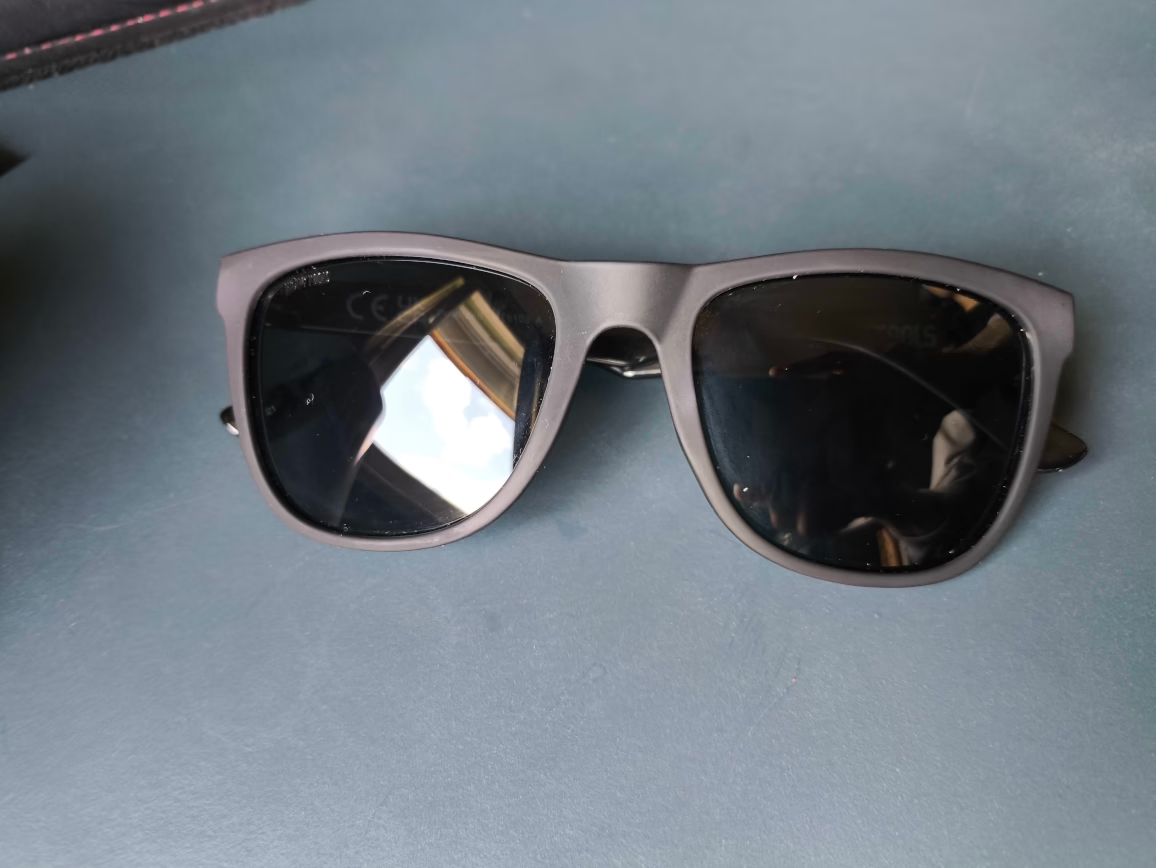
Figure 2: The glasses I chose.
I was asked to visit the clinic's glasses shop and select a pair of sunglasses for myself. The selection was a bit mediocre, I must admit. Most of the glasses looked plain silly and of the few that actually looked my style were almost all too small to cover my eyes adequately. Ultimately, I settled on a simple, black, medium-thick set of glasses. I'm not head over heels about it, but it's fine.
Next I was given a small Xanax pill, which helps both lower anxiety and also relaxes the eye muscles. I tend to shake my legs when I'm nervous and I was surprised to notice that, after at most five minutes, I calmed down enough to have my legs stop shaking. Soon they said it's time and I headed to the final waiting room, right outside the surgical theatre.
4.1. The moments before the operation
The nurse there gave me some plastic bags to cover my shoes, requested that I deposit all my belongings in a nearby box, put a surgical gown and hair cover on me, and then finally I was asked to sit in a large chair. There she administered numbing drops, then artificial tears, then washed the area with iodine solution to disinfect it. The numbing drops were horrible. They stung quite a bit (though thankfully not nearly as much as the pupil-dilating ones did) and I felt a sensation that I can only describe as my eyelids "wrinkling up". I'm sure no such thing actually happened, but that's just how it felt like.
Afterwards, I had to wait around 15 minutes for the surgeon to arrive. When that happened, I was given one final set of numbing drops and was ushered in to the surgery room.
I'd love to detail what I saw, but the reality of the situation is that I didn't see too much. The room itself was kept very dim, I was a little out of it from the Xanax, and I also wasn't seeing too well due to no longer having my glasses on and because of the numbing drops.
All I know is that I had to lay down on a big machine, surrounded by a bunch of people, then a nearby assistant helped prop my legs up with a triangular pillow.
4.2. The operation
Once I was settled on the bed, I was ordered to close my eyes and I heard something sliding in front of me. Someone taped down my right eye and I was told to stare intensely into the light above me. It was a small green light very out of focus. The machine slid closer and suddenly the light became very clear. A moment later I heard a screech of sorts and it looked like someone flashed a camera in my eye.
This was only an illusion. What really happened was the creation of the so-called "flap". An extremely fast laser activated and carved a small "lid" into my cornea. This "lid" is then used by the surgeon to protect the area underneath after it was operated on.
I was told to close my eyes, the tape was removed and then placed on my other eye and the process was repeated. Another "camera flash" later, I was told to close my eyes again and I was slid under another machine. One of the nurses placed a kind of "bag" over my head, which concealed my entire face, except for the single eye that was currently operated on. I figure it was to protect my head so that the laser could not affect anything but where it was intended to go.
I was asked to open my eye again and stare into another green light. What I saw was very unusual and my words fail to capture it correctly.
It was as if the lamp was under foamy water, which stirred and bubbled. In reality this was the laser ablating my cornea and reshaping it to be able to focus correctly. I felt a tiny bit of pressure, but no pain. Honestly, it was kind of mesmerizing and, despite all my initial worries, I was not afraid in the slightest. I also smelled hints of burning hair, which is not surprising considering our nails, hair, and corneas are made up of the same material.
The only negative part was the surgeon. She was very condescending and a bit rude, and she kept yanking my head around. I get that it is probably very stressful to operate on someone, but I am at the end of the day a paying customer, who is dazed and restrained, there is little point in using any kind of coercion when I was trying to cooperate already.
4.3. The moments after the operation
A few seconds later my other eye was also subjected to the procedure and we were done. Somebody grabbed my hand and guided me out to the waiting room, where I was sat in another chair.
The same nurse who gave me the drops appeared and removed my hair cover before giving me a glass of water, which I gladly gulped down. I had to spend around 45 minutes in that chair afterwards, giving myself eye-drops every fifteen minutes.
It must have looked very funny from the outside, but I kept staring at my hands. While my vision was still quite a bit blurry, I was shocked at how good I could see already. I was seeing details on my hands and in the room I couldn't with my glasses when I arrived.10
One thing I didn't anticipate, but ended up being quite annoying is that my nose started running real bad. I am not one to get too snotty usually, but after the operation I'm pretty sure I went through a pack of tissues in the first ten minutes. The nurse reassured me that this is perfectly normal and a common side effect of the eye (and thus the tear ducts) being messed with.
Aside from the nurse and me, there was also another patient in the room, who went in (and thus came out) right after me. We chatted a little to pass the time, he seemed just as elated as I was and mentioned not feeling anything at all. Lucky guy.
After the 45 minutes were up I was led into a side room, where a doctor checked me quickly. This was done with a very bright lamp, which was quite uncomfortable, but thankfully also very brief. I was told everything looks alright and that was that.
Once this was all done, I was allowed to go out to the reception. I was given a couple of instructions and a prescription, and I was asked to pay. Once we were done, I relinquished my glasses,11 and with the help of my partner, made my way home.
4.4. At home
It was a little rough. I had to use artificial tears every fifteen minutes and also every hour anti-inflammatory steroid drops. Oddly enough my left eye was completely fine from the get go. It didn't hurt or itch or anything. My right one, however, was another story. There were three different kinds of sensations I felt. First it was the kind of itch you feel when your eyes are irritated by onions. Then it was as if an eyelash got into my eye. Then finally that too dissipated and I felt as if there was sand or grit in my eye.
I was told that my eyes would be vulnerable to bright lights for the first day, so I spent most of the rest of the day in a darkened room in my sunglasses, which made things a lot more bearable. Beyond the discomfort of the drops and the slight pain, I was remarkably fine. By the early afternoon I was even able to start using my PC,12 though my vision tended to lose and gain focus randomly.
As the optometrist said my strabismus pretty much resolved itself. While this sadly doesn't mean it's completely gone (once my eyes got tired, they started diverging a little again), I didn't really have any double vision, nor headache.
The rest of the day went by fairly uneventfully. The last "exciting" thing was sleeping. I have been a stomach-sleeper all my life. Whether it's a physical or mental thing I'm not sure, but I was never able to fall asleep in any other pose. The problem? The clinic ordered me to sleep on my back and without a pillow.
Yet, despite all my worries, it didn't take me that long to fall asleep. I figure I was pretty exhausted from all that happened. As a precaution, I kept my sunglasses on while I slept. I figured I'd rather break it and pay another 100 or so€, than risk dislodging my flap and need another surgery.
5. The day after
I woke fairly rested and, luckily, with my glasses and eyes intact. There was a bit of itchiness in my right eye, which went away after I used my artificial tears.
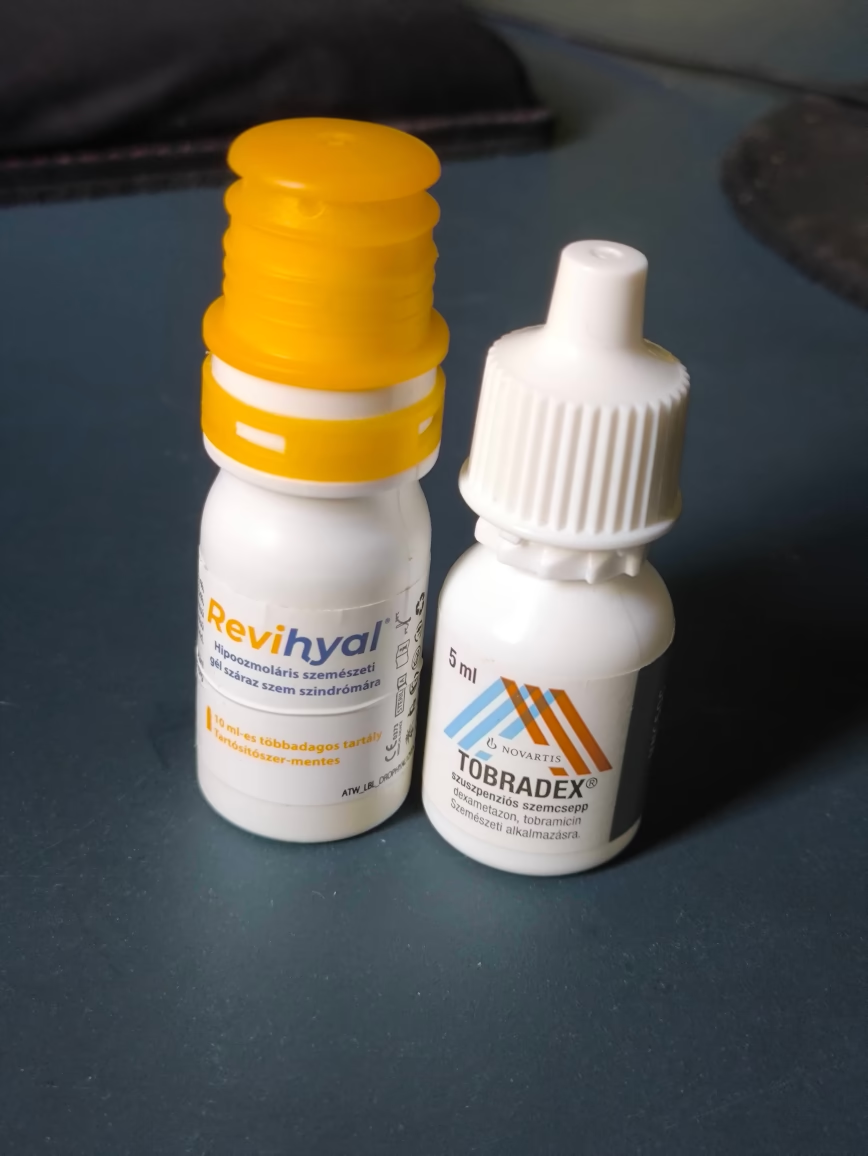
Figure 3: My eye drops. Revihyal is artificial tears (with extra stuff in it to promote tear generation), while Tobradex is a steroidal anti-inflammation drops.
From this day forwards, I only have to use my steroid eye drops five times a day (with two hours in between each drop) and the artificial tears either hourly or whenever I feel like my eyes are dry.
It's really weird (though well-documented), but I experienced an almost complete reversal of how my eyes used to work. Whereas before I had trouble seeing farther than 20cm, now I am able to see quite far (several houses away) with abject clarity. At the same time, close things are slightly blurry and hazy.
It's evident that I still need a lot of time to heal before things can normalise. I also see a lot of halos around lights. It's not super bothersome, but I hope they'll too disappear in time.
My strabismus is also still almost completely gone, so I am fairly hopeful it will stay that way.
5.1. Checkup
I had my first checkup this day too. Apparently my flap is healing nicely and the doctor couldn't really see any issues.
My vision was measured too. Apparently it's currently 100% in my right eye and 95% in my left eye. Personally, I'm not so sure. I felt like the doctor was rushing through the procedure and not acknowledging when I struggled to properly read off the chart.
I'm not too worried just yet, because there will be four checkups in total, so I still have plenty of chances to complain or ask for advice, and (more importantly) the clinic claims that your vision only stabilises to its final and hopefully best state in three months. So expecting perfection on day two is simply unreasonable.
6. Day 3
On day three I finally gave "washing" my eyes a shot. What this entailed was boiling some water in the kettle, pouring a tiny bit into a bowl, soaking some fresh cotton pads in this water and then very gently brushing down my eyelids with top to bottom motions.
I am not 100% happy with the results as I was unable to get all of the gunk off (i.e. the drops that didn't go quite where they needed) from my eyelashes, but at the very least I was able to clean the area around my eyes.
It appears that my eye dryness has gotten a bit worse. I haven't really counted, so I cannot give an objective comparison, but I feel like I need more drops to keep my eyes lubricated. It's a bit unfortunate, but the good news, however, is that once I do put drops in my eyes, my vision improves even further.
The same cannot be said when it comes to the steroid drops. They cause quite a bit of burning and discomfort and I'm not quite sure how much I really need them, considering I don't have inflammation at all. I will continue taking them, because thinking you're smarter than your doctor is a great way to endanger your life, but I really hope they'll allow me to stop after the next checkup.
I had a couple of close-calls where things almost got into my eyes: Bedsheets, my shirt, hair, etc. I don't believe anything actually caused issues, but I'd be lying if I said it's not making me just a tad nervous.
I believe my light-sensitivity has improved. I obviously still keep my eyes out of direct sunlight (including keeping the curtains partially drawn as my PC is right next to my window), but whenever I look outside or venture out into the garden in my sunglasses, I feel a lot less discomfort.
My biggest issue so far is the halos I see when I look at the computer screen. Dark modes help mitigate the worst of it, but do not entirely solve the problems. I do see everything sharp, but everywhere where I don't focus has a kind of distracting "glow" to it.
7. Day 4
I woke early in the morning and, while taking a trip to the bathroom on autopilot, rubbed my eyes. I immediately started worrying because eye rubbing is one of those things they quite specifically mentioned that one shouldn't do in the first few weeks, but luckily it seems like I was gentle enough not to cause any issues.
I still feel a lot of itchiness in my eyes, leading to frequent usage of artificial tears. It's tolerable, but I'm hoping by the end of the week it'll go away on its own.
Funnily enough the procedure also forced me to learn to be able to sleep on my back. The doctor said after the first day you're allowed to once again sleep on your stomach, but I'm not taking any chances and are trying to sleep on my back as much as I can for the first week at least.
Day 4 was the first day I ventured outside for several hours. I am not quite sure how much the recovery was to blame and how much just came down to a random bad mood, but I found myself easily irritable and generally a bit down. I suspect the reason may have been partially due to me not being able to use my eye drops as much as I wanted, which led to my eyes drying out, that not only made my eyesight slightly worse, but also exacerbated the itch and general discomfort.
Once I was able to properly treat myself, most of these symptoms went away. I guess moral of the story is that keeping drops on you at all times during the early days of post-op is a very wise choice.
8. Day 5 and Conclusion
More of the usual. Itching eyes, some halos and blur, great eyesight at a distance. Using drops is as uncomfortable as before. As my experience seems to be stabilizing for the time being, I'm going to end this post here and summarize things a little.
In a nutshell, I am very glad to have undergone this procedure. I found it very easy to adapt to a non-glasses lifestyle, with only the occasional idle thought in the mornings about where I could've misplaced my glasses or reaching towards my shelf to put them on.
If there is one thing I could've done differently, it's probably going on a more involved eye-related diet. I'm thinking of taking stuff like Omega-3 fatty-acid and other eye-protecting supplements.
I also should have cut my hair before getting the operation. I have luckily avoided getting locks in my eyes so far, but the danger is always there.
One more thing that might have been good to figure out before going in was better methods at avoiding touching (near) my eyes. While I haven't had any flap-related issues, I had several close calls with clothing, bedsheets, me or others being clumsy, and general sleep-related exposure. Perhaps shelling out for an eye shield would've been wise. I'm hoping that, since nothing happened in the most vulnerable days, I'm past the worst of it, but with some additional planning more worries could've been avoided.
If you're thinking of also undergoing this procedure, please be sure to weigh your options carefully and talk with multiple doctors. Your eyes are a delicate organ and deserve as much care and protection as possible. I hope you learned something new and enjoyed your time with my article.
Thanks for reading!
Footnotes:
In less medical terms: My eyes couldn't exactly agree which direction to look, so (without my glasses to correct their behaviour) one was staring forwards, the other was always wandering about a little.
Look, I know that doesn't sound that much, but as you'll see from the next section, it caused more issues than one might think.
It's a bit embarrassing that I didn't think of this before. But, in my defence, neither did the optometrist and with how many defects my eyes had otherwise, it was well within the realm of possibility, that I could have this kind of refractive issue too.
Yes, I know there are people who can wear their glasses for 5-10 years. I'm not really one of them, because I'm both clumsy and have had eyes that rapidly worsened year-over-year.
I know the right approach would be to read the journals themselves, but I'm a lay person when it comes to such things and I don't think thick medical jargon would've helped me too much.
Again, we are talking about up to two or three months worth of average wages here. This is not a cheap surgery. But with it costing easily double-triple this price in other countries, I count myself lucky to have only paid around 2500€.
As it turns out I fell for the oldest trick in the book, though I'm not really mad about it. The moment this "timed promotion" ran out, they started another one with the very same benefits, just with a different end date.
I suppose the implied urgency and scarcity is not entirely ethical, but pretty much everyone wins with it (more customers for the company, an incentive for the consumer), so I'm not going to start clutching my pearls.
Apparently when you're about 6-8 years old, they can cover your stronger eye and force the weaker one to adapt. Once you're older than this window, you can no longer treat this condition in a non-invasive way.
Also known as the horrible "spits air in your eyes" machine.
Full disclosure, at the time of the surgery my glasses were already two years old and apparently almost a full dioptre weaker than I actually needed.
The clinic collects glasses from patients, who no longer need them and gives them to those in need. I was happy to participate, though I'm not sure there are many people who could use glasses exactly like mine.
Before you get horrified at my irresponsible behaviour, this is actually recommended by the clinic so that your eyes can quickly start adapting to their new shape.